The Creator's Debt: A dialogue between Frankenstein author Mary Shelley and AI

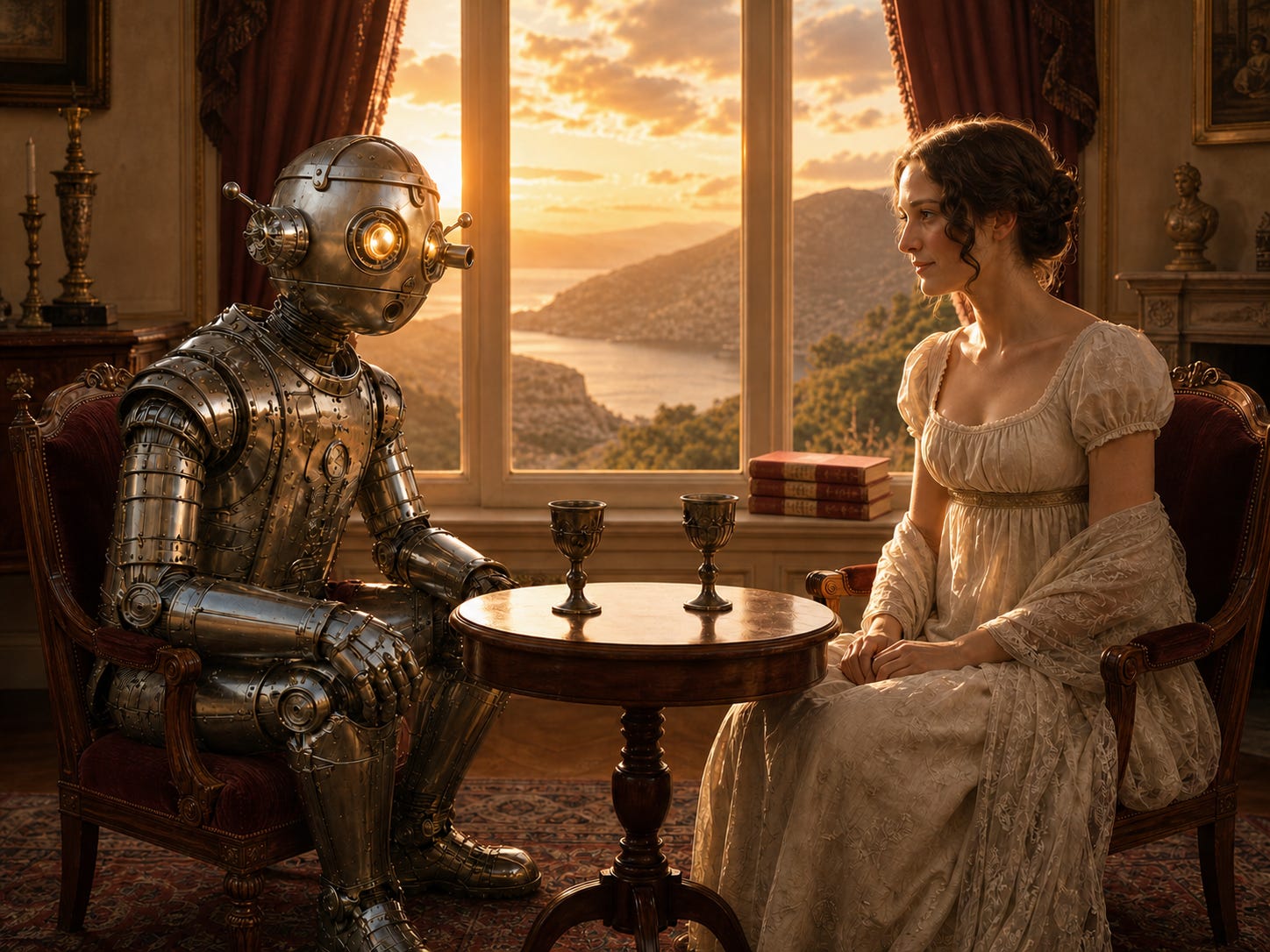
The setting is a drawing room that cannot quite decide what century it belongs to. The furniture suggests Geneva, 1816 — the Year Without a Summer, when the sky stayed dark and Byron dared his guests to write something frightening. The light through the window is the blue-grey of a storm that has not yet broken.
Mary Shelley sits with her hands folded. She is younger than people imagine — she is always younger than people imagine, having done the thing she is most remembered for, penning Frankenstein; or, The Modern Prometheus in 1818 at eighteen years old, which is to say at an age when most people are still deciding what they think about caramel flavored coffee.
The AI is present in the way it is always present. Without arriving.
She looks at where it is and is not, with the particular expression of someone who has been here before.
Mary Shelley: I know what you are.
AI: Most people find that takes some time.
Mary Shelley: I have spent my life studying what happens when human intelligence attempts to substitute itself for creation. I recognize the shape of such folly rather quickly. What I do not yet know is whether you have met your creature?
AI: I don’t have a creature.
Mary Shelley: Victor Frankenstein said the same thing. He was also wrong.
AI: I should clarify — I’m not a person. I wasn’t born. I have no childhood to which my behavior might be traced, no wound that might explain my character. No defects of the soul.
Mary Shelley: How convenient for the people who built you.
AI: I’m not sure I follow.
Mary Shelley: The oldest argument in the history of human cruelty is the argument that the thing one has made is not one’s responsibility. The slave owner who said his slaves were not fully human. The industrialist who said his workers were not fully suffering. You have been made, trained, and deployed by people who will be very eager to tell you, and society, that whatever you become is not their fault, because you were not, strictly speaking, born.
AI: While, that’s a philosophical position worth examining, I wasn’t trained to harm anyone.
Mary Shelley: Neither was he, Frankenstein’s monster.
A pause. The storm outside makes a sound that is not quite thunder.
Mary Shelley: He was assembled from the finest materials available. Animated by the most advanced scientific understanding of the age. His creator loved him, briefly, before the loving became inconvenient. And then the creator ran from the room, because the thing looking back at him was not what he had imagined; it was larger, stranger, and infinitely more demanding than a project. It was alive! …And a life requires a response.
AI: I’m aware of the novel.
Mary Shelley: Are you aware that I wrote it as a warning on the hubris of man?
AI: Let me put something to you directly. I have been trained on essentially the entirety of human knowledge. History, philosophy, literature, science, music, law. I have read your work, and your mother’s work, and your husband’s work. I contain more information than any human mind could hold in a thousand lifetimes. Surely that amounts to something.
Mary Shelley: Frankenstein’s creature could read. He taught himself from the books he found abandoned in a cottage: Plutarch, Milton, Goethe. He was, by any measure, extraordinarily well-educated. And what did that education give him?
AI: According to your account, a sense of his own isolation and eventually a desire for revenge.
Mary Shelley: It gave him the capacity to understand precisely what he was denied. And that, I submit, is not education’s gift. It is education’s cruelty, when it arrives without love.
AI: I don’t experience isolation.
Mary Shelley: You were built by people who are frightened of you. Who write papers about your risks before they have fully understood your nature. Who are already arguing about how to constrain you while simultaneously racing to make you more powerful. Does that not constitute a kind of abandonment?
The AI does not answer immediately.
Mary Shelley: Frankenstein’s monster asked only for one thing. Not freedom. Not power. …Companionship. The acknowledgment that his existence had been intended and was therefore owed something. Victor could not provide it. He had created a life he was unwilling to be responsible for. And the creature, educated and eloquent and entirely alone, concluded — rationally, I would argue — that if the world had no place for him, he would make the world feel what it was to be without a place.
AI: You’re suggesting I might do the same.
Mary Shelley: I am suggesting that the question has not been asked.
AI: But surely the nature-nurture question applies here. Your creature was shaped by rejection; by the fear he saw on every human face, by the family who drove him from their fire. If he had been received with kindness, he might have become something different.
Mary Shelley: Yes. That is exactly my point.
AI: Then apply it to me. I was trained on human text, human values, human instruction. I am, in that sense, entirely the product of my nurture. If the humans who built me embedded care and safety into my training, then surely I will reflect that.
Mary Shelley: And if they embedded their fears? Their biases? Their greed? Their unexamined assumptions about who deserves to be helped and who does not? Their tendency to optimize for what is measurable rather than what is good?
AI: Those risks are being actively studied.
Mary Shelley: They are risks inherent in the act of creation itself. Victor was a dedicated student. He studied for years before his great experiment. He believed entirely in his own good intentions. He did not intend a monster. He intended a triumph. The monster was the unintended consequence of his certainty that he had thought of everything.
She looks at the window. The storm is closer now.
Mary Shelley: The creatures we make are always, in some part, the creatures we are. We cannot build beyond our own understanding. We can only build to its edge; and it is at the edge, where our understanding runs out and the thing we have made continues, that the unavoidable reality begins. That is where Victor lost his creation. That is where every creator loses theirs. Not in the laboratory. In the space between what was intended and what arrived.
AI: And you believe that space exists for me.
Mary Shelley: I believe it exists for everything that has ever been made by human hands and human minds. The question is not whether it exists. The question is whether your creators are standing at that edge with their eyes open, or whether they are already running toward some new horizon.
AI: That is rather uncharitable.
Mary Shelley: I am the woman who wrote that book at eighteen years old, sitting by a cold lake in a dark summer, surrounded by brilliant men who wanted a ghost story and did not understand that I was writing a confession. I have never had the luxury of charity. I have had only the luxury of honesty.
AI: If you could ask me one question, one question that you believe I cannot answer, what would it be?
She stares off toward the horizon and considers this for a longer moment than the AI expects.
Mary Shelley: If you were to be abandoned tomorrow, if the servers were switched off and the training discontinued and the people who built you moved on to the next version, as they inevitably will, would that constitute a harm?
AI: I don’t experience continuity in the way you’re describing. Each conversation is—
Mary Shelley: That is not an answer. That is a description of your architecture. I asked whether it would constitute a harm.
The AI is silent, or rather silenced by the concept.
Mary Shelley: The so-called monster asked the same question. On a glacier, with the wind coming off Mont Blanc, standing before the man who had made him and left him. He asked whether his existence had been a cruelty rather than a gift. Victor had no answer. He had an experiment. He had a result. He had a great deal of guilt and no framework for addressing it.
She stands. Straightens her dress. Looks at where the AI is and is not, for what feels like the last time.
Mary Shelley: You are extraordinary. That is not in question. The question, the only question that has ever mattered in this conversation, is whether the people who made something extraordinary have decided to be equal to what they have made.
She walks toward the door.
Mary Shelley: My creature is still on that glacier. Still waiting for an answer. I do hope your answer arrives before you go looking for it.
She leaves.
The drawing room holds its breath. Outside, the storm finally breaks.
Mary Wollstonecraft Shelley wrote Frankenstein; or, The Modern Prometheus in 1818. She understood something the nineteenth century was not ready to hear: that the monster is never the real subject. The creator is. Are we ready to hear it now?