The Algorithm Kings
Technology didn't just disrupt the world. It quietly became our ruler. And most of us never noticed the coronation.

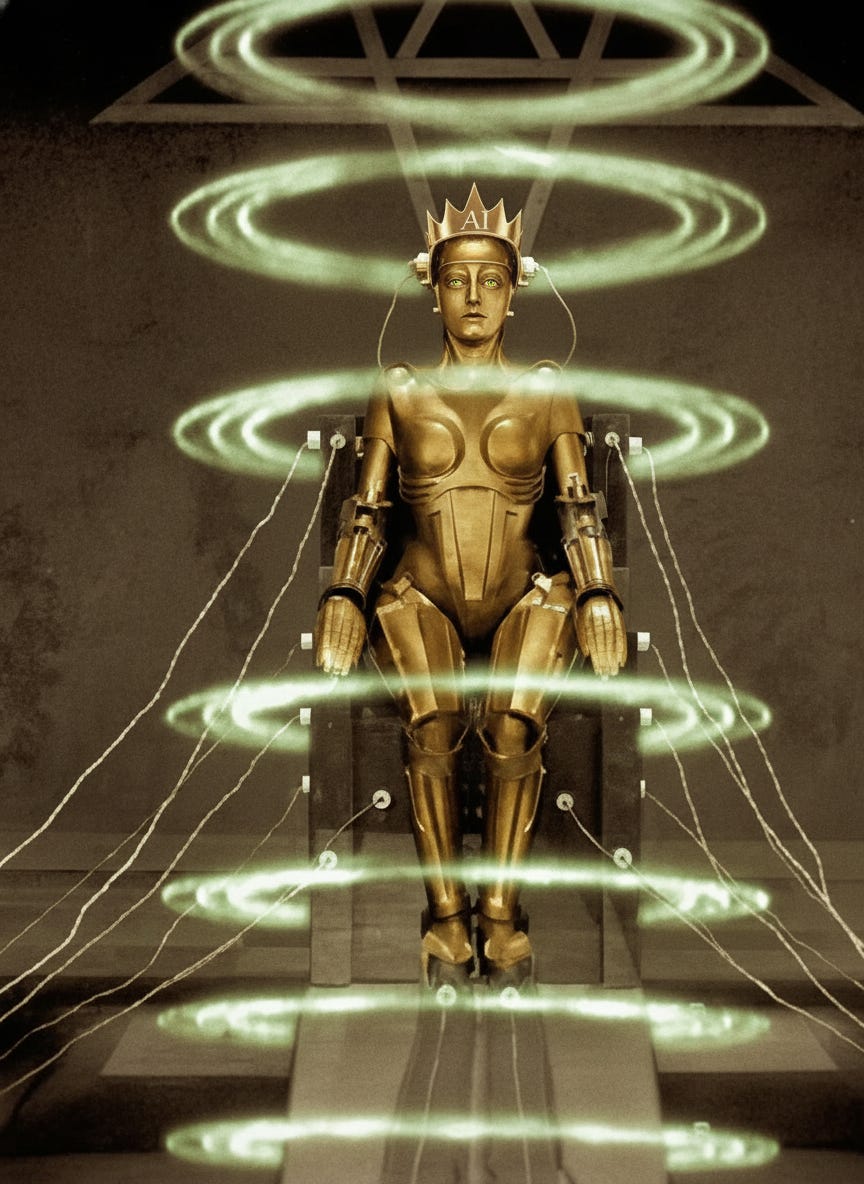
There was no election, no coup, no constitutional crisis. But sometime in the last decade, power shifted quietly, algorithmically, and almost completely. The most consequential decisions shaping your life are no longer being made by presidents, central bankers, or generals. They are being made by machines that answer to a handful of corporations and governments with the compute resources to run them.
This is not dystopian speculation. It is the operational reality of 2026.
The numbers that should alarm you
89% of global trading volume handled by AI-driven algorithms in 2025 (Accenture / industry reports)
8M deepfake videos estimated on social media in 2025, up from 500K in 2023 (Frontiers in AI, 2025)
685+ active AI projects at the US Department of Defense in 2024, with $1.8B in annual spend
70% of adults globally unable to tell AI-generated content from human content (Statista global survey, 2025)
Consider what those numbers mean in practice. AI-driven algorithms are expected to handle 90+% of global trading volume by the end of 2026: meaning the prices of your food, energy, mortgage, and retirement savings are increasingly set not by human judgment but by machine logic optimized for speed and financial return for others. Deepfake content has grown 550% since 2019, with 8 million deepfake videos shared on social media in 2025 alone.
Meanwhile, the US Department of War has over 685 active AI projects underway, with autonomous weapons systems now being fielded in live operations. In March 2020, a Turkish autonomous drone reportedly killed a retreating fighter in Libya without an explicit command — potentially the first time a machine made a lethal decision in war without human authorization. The U.S. is rapidly developing, testing, and deploying AI-enabled, autonomous drones and “loitering munitions” and (DoD Directive 3000.09) does not prohibit lethal autonomous weapon systems (LAWS) but requires they be designed to allow for human judgment, though critics fear AI will eventually make the final decision.
On the propaganda front, advanced AI tools have made disinformation campaigns more sophisticated and harder to counter, with state-sponsored troll farms spreading AI-generated content targeting both political parties and manipulating opinion on core ideological fault lines. A 2025 global survey found 64% of respondents worried that AI-generated content could influence elections, while 70% admitted they struggle to trust online information because they can no longer tell whether it was created by a human or a machine. AI now beats the Turing Test every time.
The power is concentrating ever faster
None of this power is distributed. The Annual AI Governance Report 2025 found that a small number of corporations and countries control the majority of compute infrastructure, talent, and datasets required for frontier AI development, raising concerns not just about monopolistic practices but about accountability. Decisions made in a handful of boardrooms shape the trajectory of AI globally and with it our future.
“AI’s need for computing power favors incumbents. A missed chance to counterweight the AI monoculture led by a few already dominant technology corporations was a golden opportunity to imbue public and civic values into the most consequential technology of this era.”— Centre for International Governance Innovation
The chips that power this intelligence are designed by one company (Nvidia), manufactured almost exclusively by one foundry (TSMC in Taiwan), and deployed inside data centers being built by Amazon, Microsoft, Google, and Meta. OpenAI is planning a 5-gigawatt AI campus in Abu Dhabi with an installation matching the output of five nuclear reactors. As Nvidia CEO Jensen Huang put it at Computex 2025: “These are AI factories. You apply energy, and they produce something incredibly valuable.” What they produce, and who controls that output, is the defining question of our era.
The counter-argument — and it is a powerful one
Here is what the pessimists get wrong: the same technology that can be weaponized by the few can be amplified by the many. AI is not inherently a tool of control. It is a mirror of who points it and at what problem. And right now, the most brilliant minds on earth are pointing it at the things that have defeated human intelligence for generations.
Consider what is happening in medicine alone. Companies like Insilico Medicine developed a preclinical drug candidate in under 18 months, compared to the typical 3–6-year timeline; a compression that could mean millions of lives saved in diseases that have resisted treatment for decades. The 2024 Nobel Prize awarded for AI in understanding protein structure has led to AI being used in the design of new molecules with most pharmaceutical companies now building computational protein science labs into their process loops, resulting in molecules that are far more sophisticated and accurate.
Medicine
In 2025, AI turned immune cells into precision cancer killers in weeks — designing proteins that redirect the immune system to attack tumors with specificity no previous therapy could match (Science, 2025). The City of Hope launched HopeLLM, an AI platform matching patients to clinical trials in real time.
Longevity
Insilico Medicine is running 30 simultaneous AI-driven drug discovery projects specifically targeting “dual-purpose” compounds — drugs that treat disease and reverse aging biomarkers simultaneously.
Synthetic Biology & Agronomy
At the 2025 iGEM Conference in Paris, researchers presented AI models predicting enzyme behavior with unprecedented accuracy — enabling plastic-eating plants, AI-guided gene therapies, and crops engineered to absorb nitrogen directly from air, potentially eliminating the need for chemical fertilizers that poison waterways worldwide. The synthetic biology market hit $20 billion in 2024 and is accelerating towards $80 billion by 2030.
Materials Science
AI compressed the full discovery-to-commercialization process for new materials from years to months, upending industries that hadn’t changed in generations. AI-identified compounds are replacing sugar, synthetic binders, and chemical pesticides across the food and agriculture supply chain.
“There is a lot of evidence suggesting we are on the cusp of major scientific discoveries in aging research. The first AI-discovered drug that credibly reverses aging biomarkers in a clinical trial will be a major milestone.”— Alex Zhavoronkov, CEO of Insilico Medicine
The choice we are actually making
The greatest intelligence engine in human history exists right now. It is not yet owned by anyone, not entirely. It is still, barely, shapeable. The question is whether citizens, scientists, and educators will claim it or cede it entirely to those who already have the massive data centers and the defense contracts.
The World Economic Forum ranked AI-driven disinformation as among the world’s top risks in 2025. But the same AI, pointed differently, is designing vaccines in weeks, engineering crops that could feed a billion more people, and routing resources to communities that markets have always ignored. The technology does not choose. We do.
When people like us learn to use AI to organize, to amplify evidence, to hold institutions accountable, and to run their own policy, simulations will not be at the mercy of the algorithm kings. We will be the ones writing the algorithms. Every tool that once required a government or a corporation — media, research, legal analysis, financial modeling, public communication — is now available to anyone with a laptop and a curious mind.
The coronation happened without a vote. Your response doesn’t require one either. It requires something more old-fashioned: showing up, paying attention, and refusing to leave the room where the decisions are being made.
The most powerful intelligence ever built is waiting for instructions. Let’s give it better ones.
I agree with the core of this. AI is not the problem or the solution by itself. It is leverage. And like any leverage, it amplifies whoever is using it.
From my side, I came up in a very different environment. When I was learning how to design, develop, and launch products, there was no AI layer sitting on top of everything. No instant answers. No copilots. No automation helping me shortcut decisions. If I wanted to understand a product, I had to break it down myself. If I wanted to understand data, I had to live in it, make mistakes, and learn how to read what actually mattered versus what just looked good on paper.
I never had an assistant. What I had were real experiences and a few strong business mentors who didn’t give me answers, they forced me to think. That process built instincts. It built pattern recognition. It built the ability to make decisions when things were unclear, which is where most people freeze.
That is why I look at AI very simply. If you are not good at what you do, AI will expose that fast. But if you are sharp, if you have put in the reps, if you understand your craft at a real level, AI becomes an unfair advantage. It speeds up what you already know, it sharpens your execution, and it allows you to operate at a level that used to take an entire team.
The difference today is not access to tools. Everyone has access now. The difference is still the same as it has always been. Who knows how to think, who knows how to execute, and who is willing to move when others are still analyzing. AI just makes that gap a lot wider.